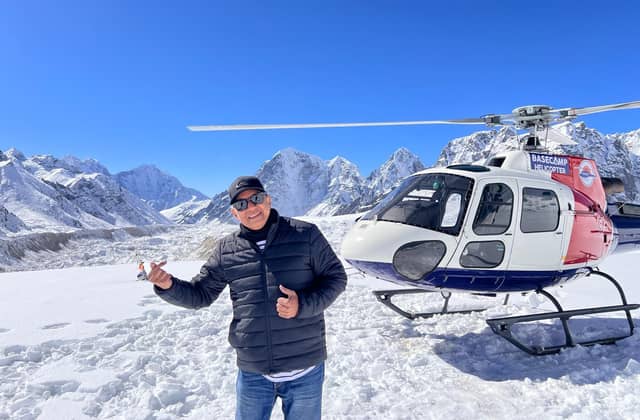
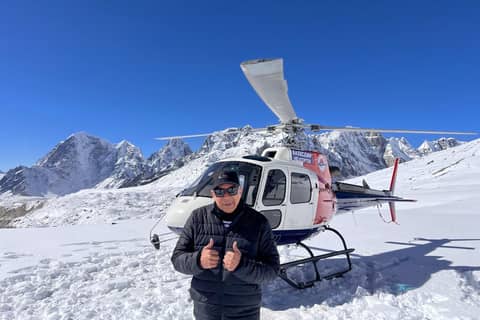
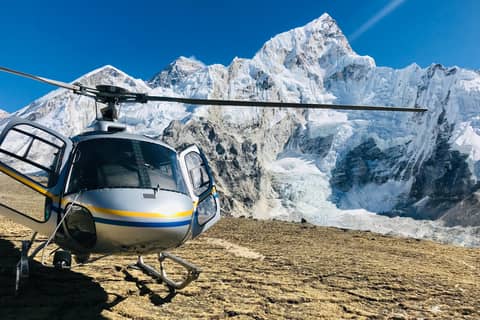
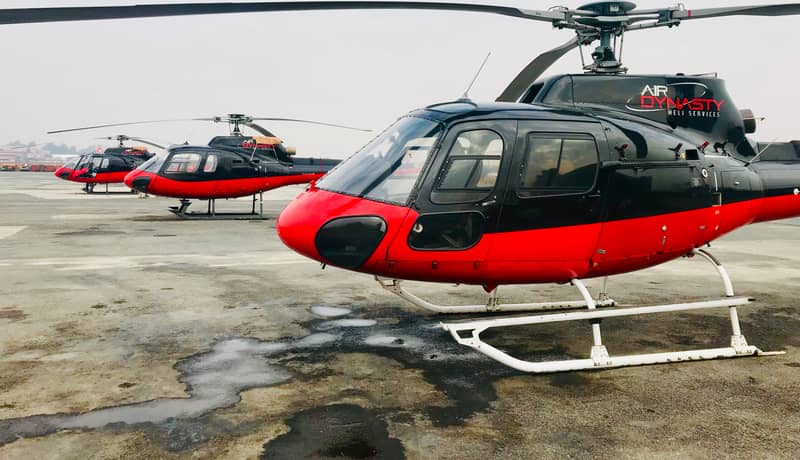
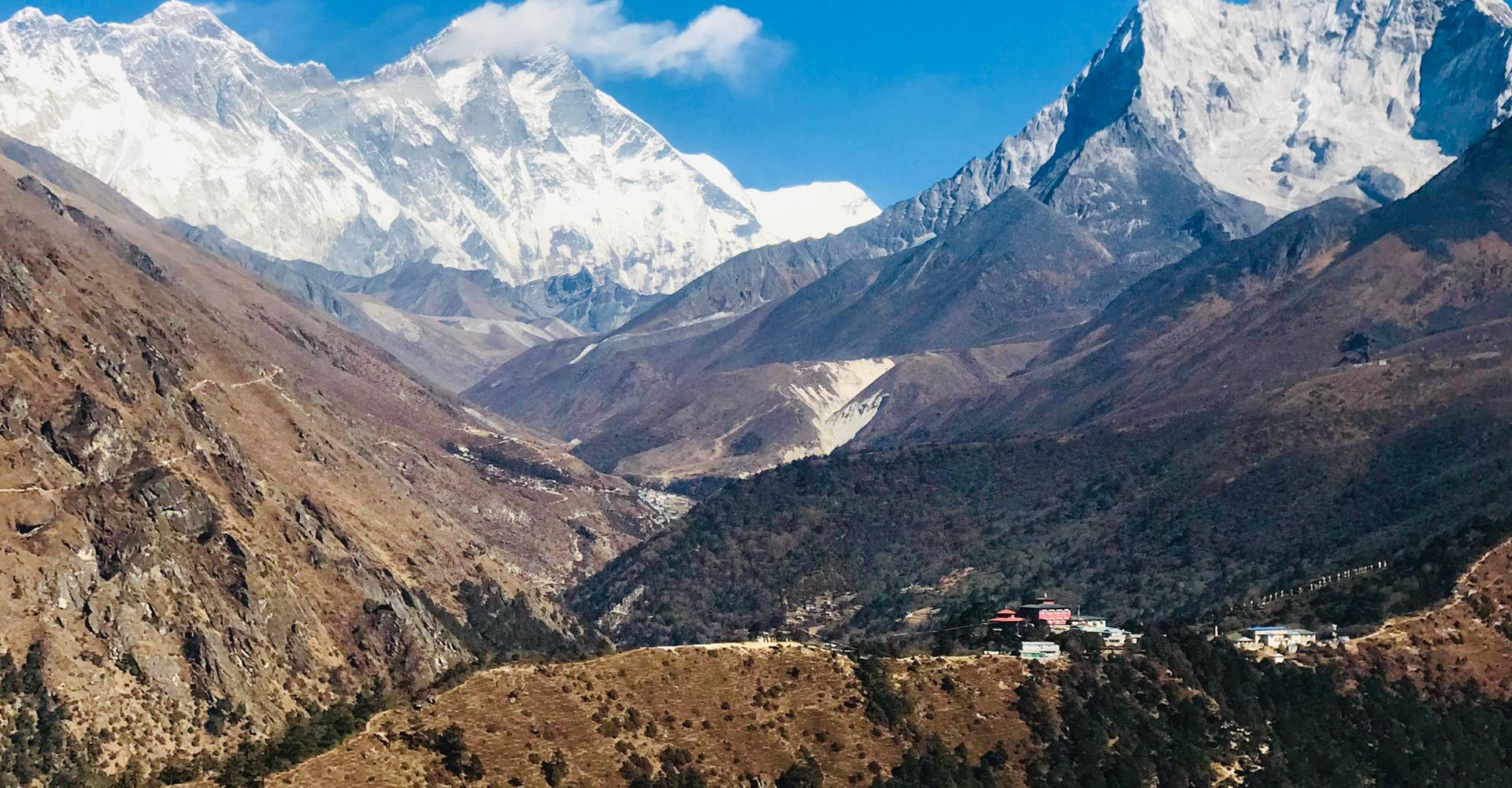
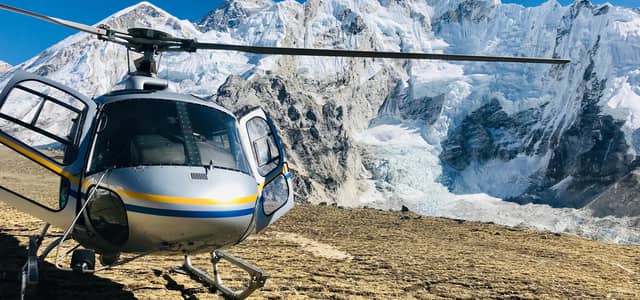
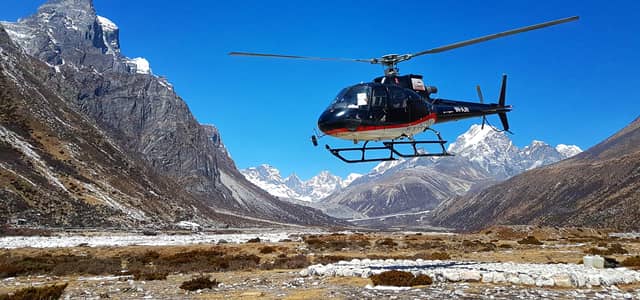
Most reviewedTop rated on GetYourGuide1 / 3The most-reviewed landing flight
Landing listed as included- Landing at Kala Patthar listed as included
- Oxygen on board
- Live guide in English

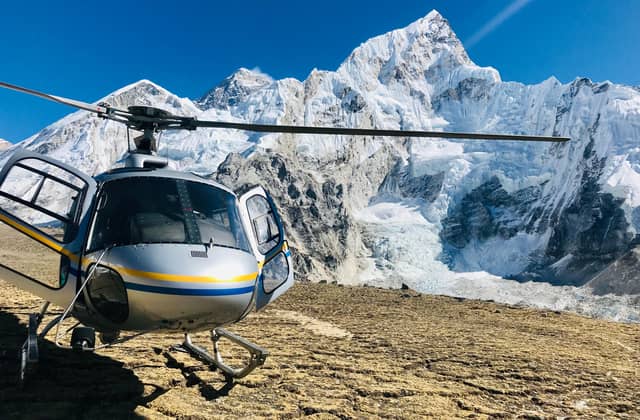
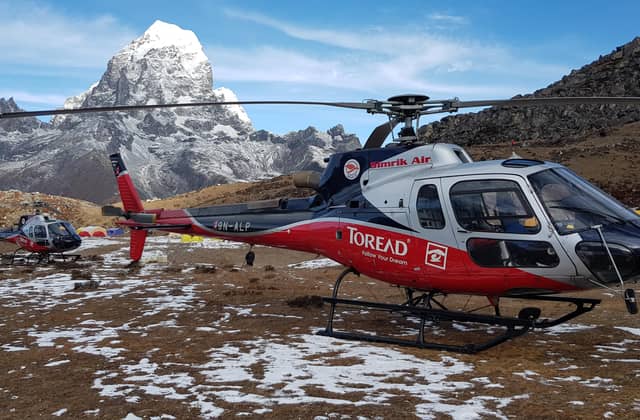
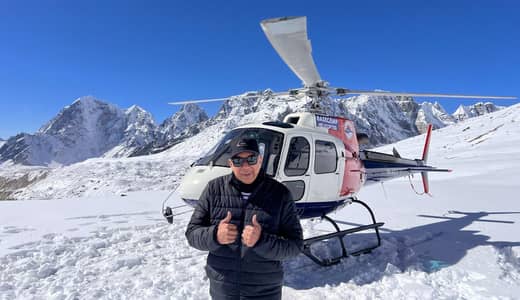
Fly from Kathmandu to the foot of Everest and be back for lunch. It flies over base camp, stops for breakfast at 3,880 m and, on some tours, lands at Kala Patthar.
An Everest helicopter tour is a 4–6 hour morning flight from Kathmandu over Everest Base Camp, with a stop at Hotel Everest View and, on some tours, a landing at Kala Patthar. A shared seat costs about $1,250–2,200 per person.
Check dates and today's price: the most-reviewed landing flight on GetYourGuide
Book by one question first: do you want to stand at Kala Patthar, or is the flight and breakfast at 3,880 m enough? Tours that promise the landing cost about $1,450–2,150 per person on GetYourGuide; flights without it start near $1,375. The listings say very different things about the landing, so each pick states exactly what its page promises.


Most reviewedTop rated on GetYourGuide1 / 3

Lowest price with a landing1 / 3

Pay only if it lands1 / 3

Shortest day1 / 3

Breakfast flight1 / 3

Whole helicopter1 / 3Four listings state a Kala Patthar landing plainly, one sells it as an add-on, and two contradict themselves on the same page. No listing can promise it for your date: weather, the load and the permissions in force that morning decide, and the pilot has the last word.
| What its page says | ||||
|---|---|---|---|---|
| The most-reviewed landing tour ★ 4.91 · 30 reviewsMost reviewed | Landing stated | Lists "Landing at Kala Patthar" as included, though its description also says "fly over". | $2,135 | Check dates |
| The two-at-a-time landing tour ★ 5.0 · 1 reviewCheapest with a landing | Landing stated | Includes a landing reservation, two people at a time, subject to weather. | $1,695 | Check dates |
| The private tour with a stated landing No reviews yet | Landing stated | Names a 10-minute photo stop at Kala Patthar; $1,456 per person. | $1,456 | Check dates |
| The December-only landing tour ★ 5.0 · 1 review | Landing stated | States a landing with a bad-weather caveat; $1,990 per person, fees included. | $1,990 | Check dates |
| The pay-if-it-lands tour ★ 5.0 · 1 review | Paid only if it lands | Charges $300 for the landing only after it happens, and says many flights cannot land even after promising it. | $1,574 | Check dates |
| The 3-hour flight ★ 4.39 · 17 reviewsLowest price | No landing | Does not land at Kala Patthar; a guest notes a landing must be arranged privately for an extra fee. | $1,375 | Check dates |
| The Hotel Everest View landing tour ★ 4.6 · 2 reviews | No landing | Lands at Lukla, Pheriche and the hotel only. | see the listing | Check dates |
Two other listings advertise a "guaranteed landing" and, lower on the same page, say landing at Kala Patthar is prohibited by the government and possible only by private shuttle from Lukla for two people at a time. Ask the operator in writing which of the two applies before you pay.
No. An Everest Base Camp helicopter tour flies over base camp at 5,364 m and does not land there. Operators and the Kathmandu Post say the same thing: only rescue and expedition supply flights land at the camp. The name in the title describes where the flight goes, not where you step out.
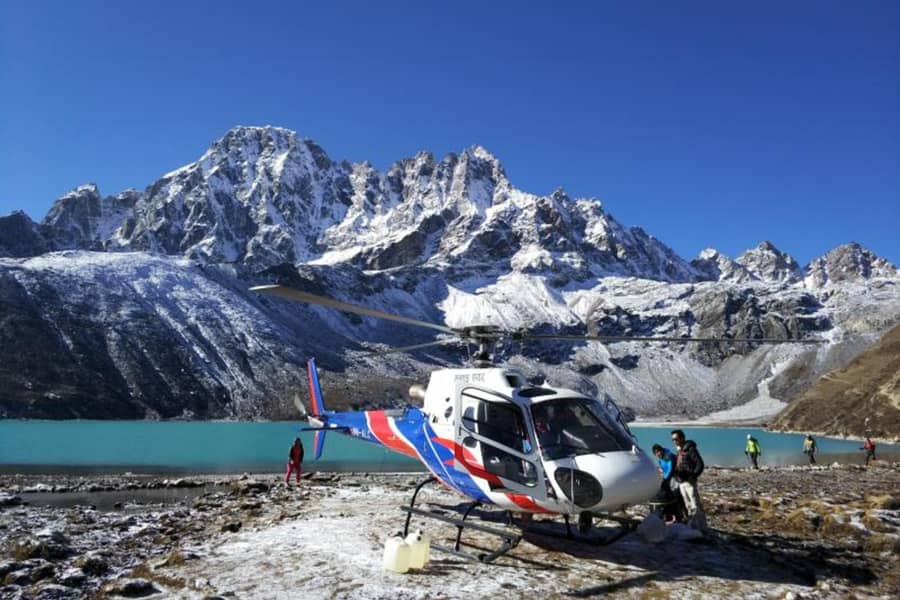
What the tours call a base camp landing is in practice a landing at Kala Patthar, a viewpoint on the ridge above Gorak Shep or at Pheriche, about 1,200 m lower. One operator's own answer gives the reason: the camp sits on a moving glacier and the landing risk is high.
GetYourGuide listings with "Everest Base Camp" in the name describe the camp as a flyover or pass-by. The places they name for landings are Lukla, Pheriche, Kala Patthar and Hotel Everest View.
See the flights with a stated landing
In practice in late 2026 only two passengers at a time go on from Pheriche or Lukla to land at Kala Patthar; the Kathmandu Post reports up to four per helicopter as far as Lukla, while operators list five seats. No current official document that approves every high-altitude landing was found, and the dispute between local bodies and the aviation authority is described as unresolved.
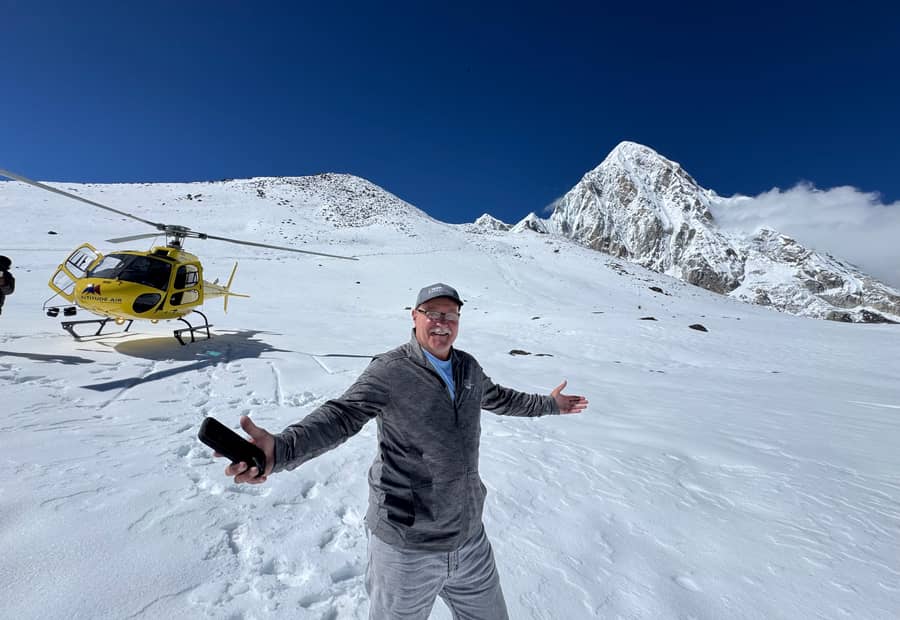
Expect about 10–15 minutes at Kala Patthar, 30–60 minutes at Hotel Everest View and 10–15 minutes at Lukla. Sources give 5 to 20 minutes for Kala Patthar, and one traveller's report describes about 5 minutes outside the helicopter, so plan your photos before you step out.
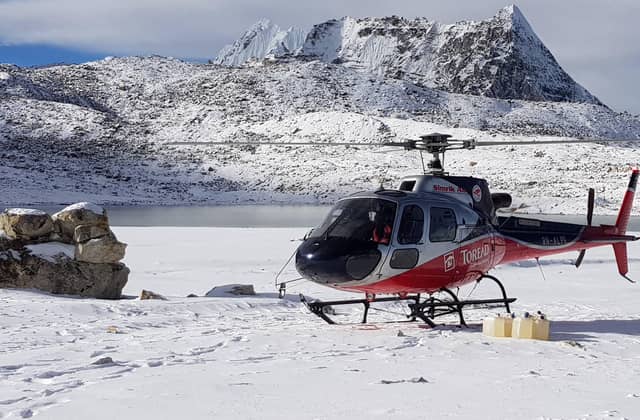
The stop is short on purpose. Passengers arrive at about 5,545 m (a GPS reading gives 5,644 m) without acclimatising, so operators cap the time to limit altitude problems, and the weather up there turns quickly. The helicopter stays on standby with oxygen inside.
Listings state their own figures: 10 minutes at Kala Patthar on one, 10–15 on another; 30 minutes at the hotel on the breakfast flight, 45 minutes to an hour on most others. Several pages give no figure at all.
The Everest Base Camp helicopter tour runs Kathmandu → Lukla → Pheriche → Kala Patthar and base camp → Hotel Everest View → Lukla → Kathmandu. Hotel pickup is between 5:30 and 6:30 am and most guests are back at their hotel by about noon.
Check-in with passport, weighing, take-off between 6:30 and 8:00 am.
About 45 minutes' flight, then 10–15 minutes on the ground to refuel.
The group is split; two or three fly up while the others wait.
A flyover of the camp at 5,364 m and, on landing tours, a short stop at Kala Patthar.
Breakfast or a photo stop of 30–60 minutes.
Landing between 10:00 and 11:30 am.

The full timings are in the Everest helicopter tour itinerary.
Check dates for the landing flight
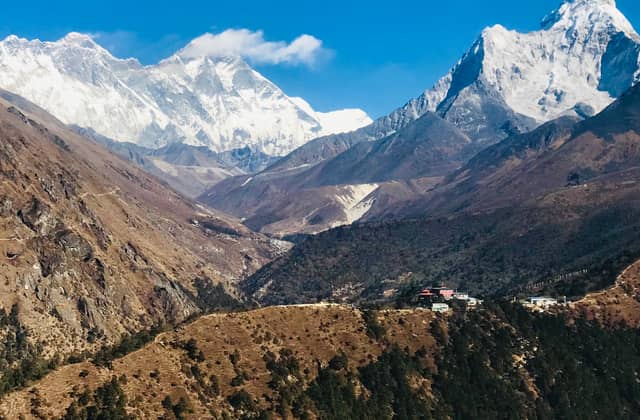
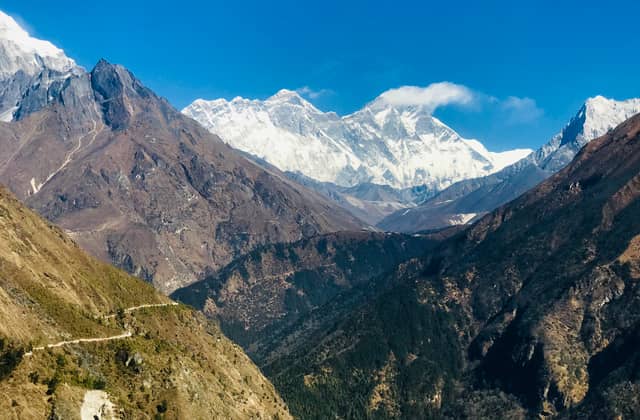
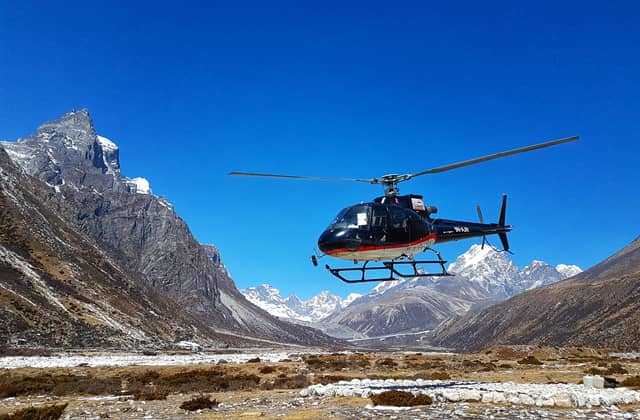
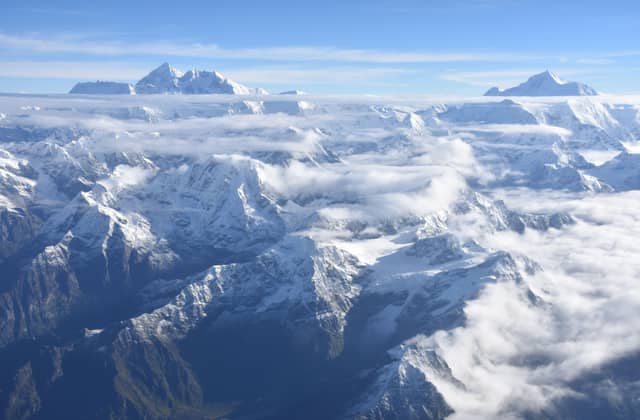
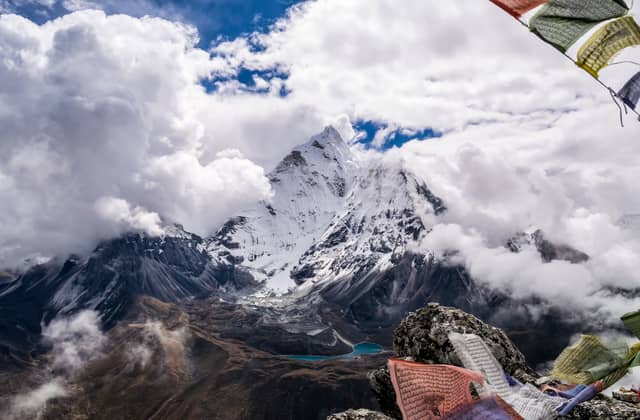
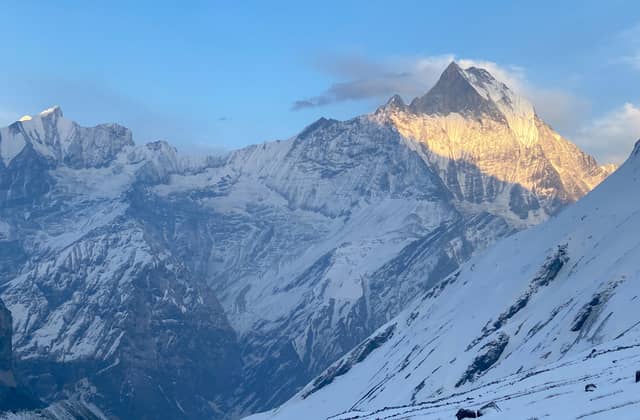
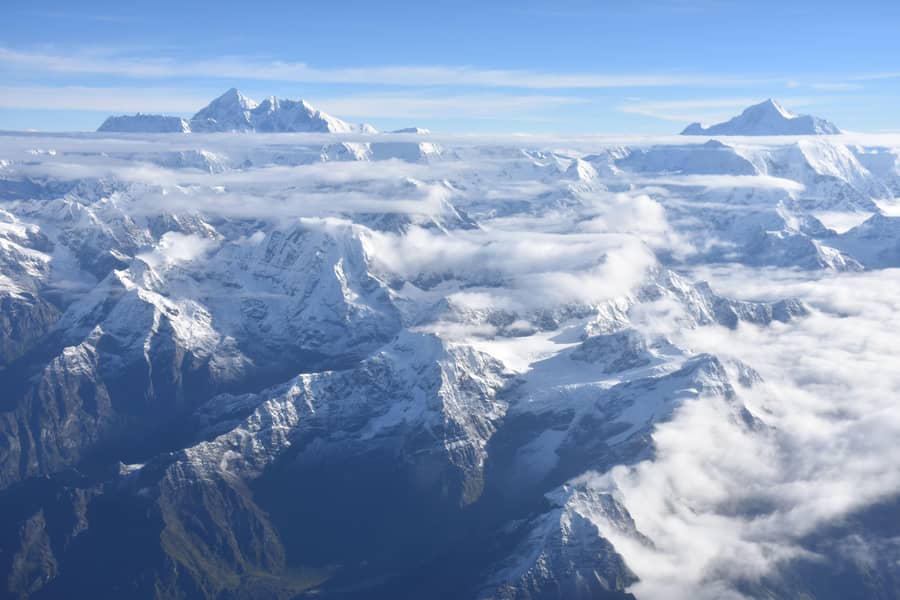
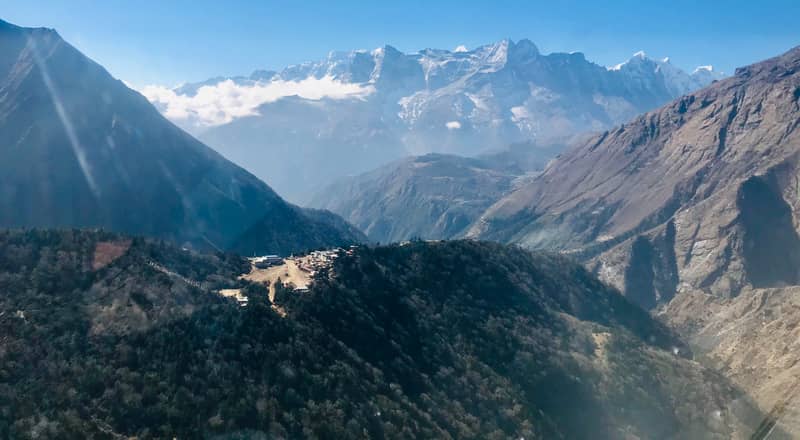
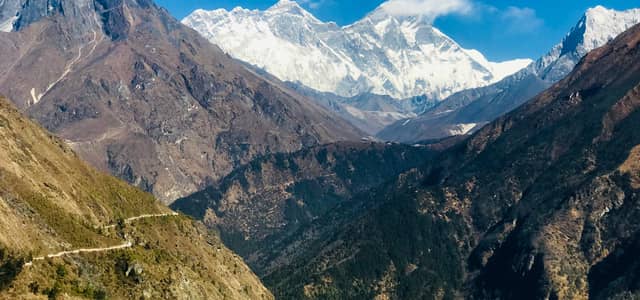
An Everest helicopter tour is a same-day flight from Kathmandu into Sagarmatha National Park and back, in a five-passenger Airbus H125. It replaces a trek of about two weeks with one morning. You see Everest (8,848.86 m), Lhotse, Nuptse and Ama Dablam, the Khumbu Glacier and Icefall, Namche Bazaar and Tengboche Monastery.
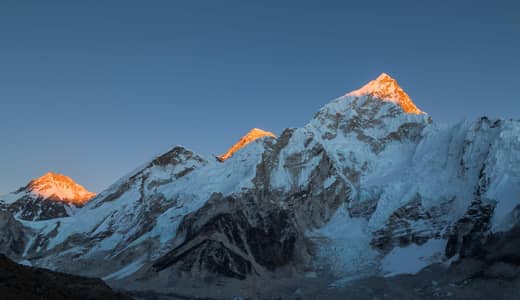
From Kala Patthar the view takes in Everest, Nuptse and Changtse; Nuptse hides Everest's summit from much of the surrounding valley, which is why the viewpoint matters. In April and May expedition tents stand at base camp; in October and November the camp is empty, because it is rebuilt each spring.
The helicopter is not the plane. The fixed-wing mountain flight stays about an hour in the air with no stops; the helicopter lands, refuels at Lukla, and puts you on the ground in the mountains.
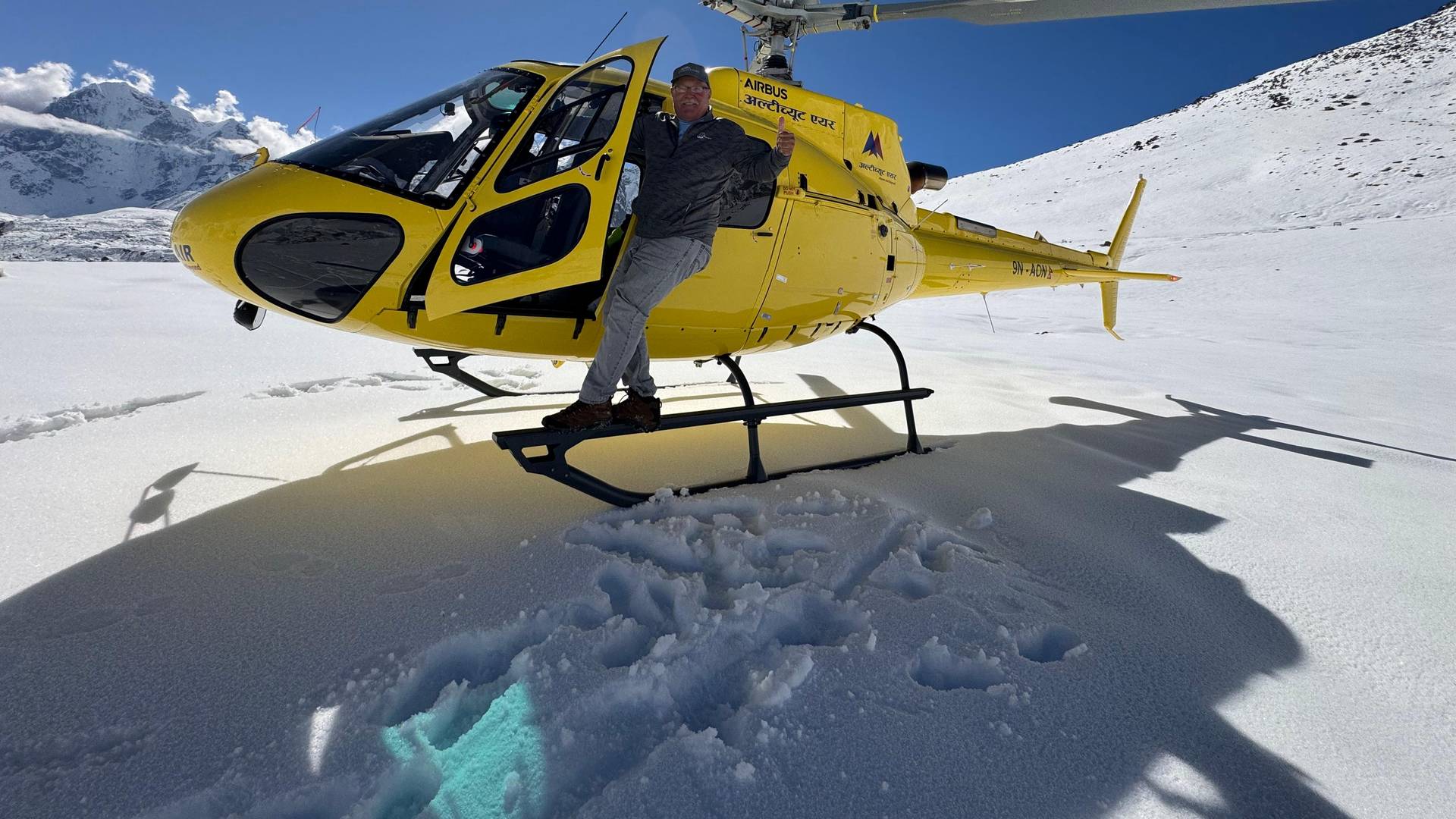
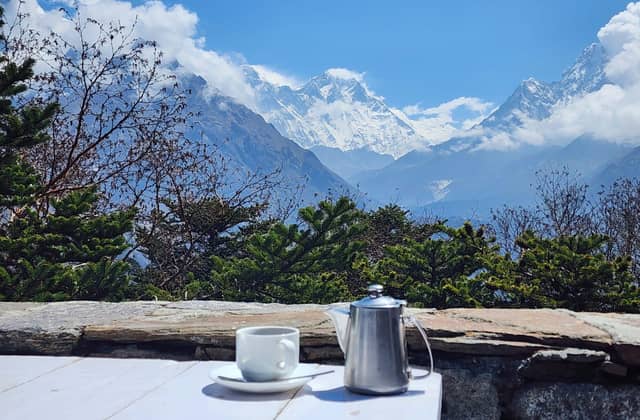
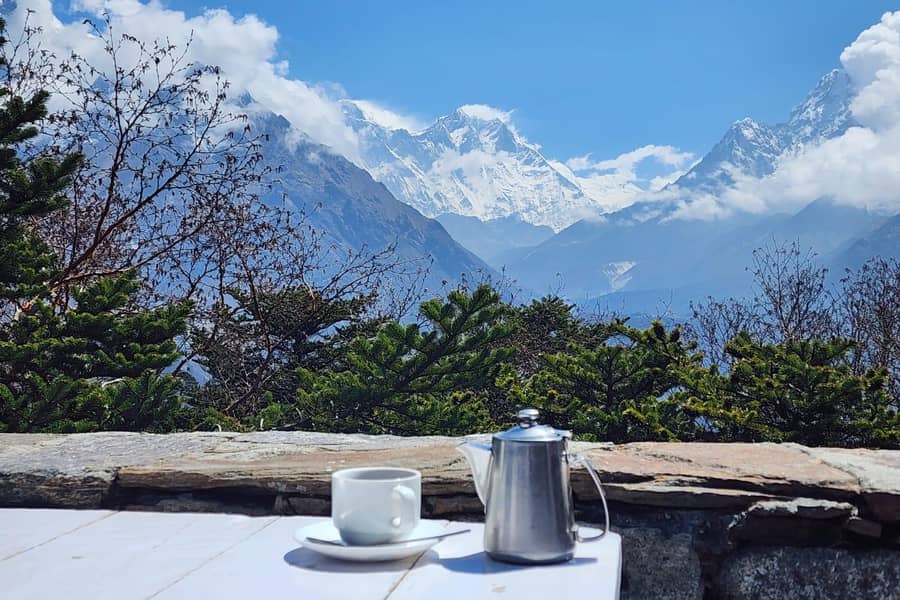
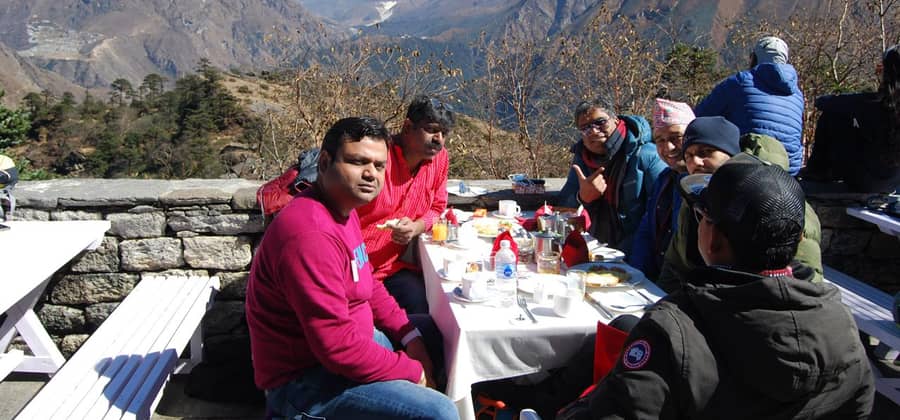
Breakfast is a 30–60 minute stop at Hotel Everest View, at about 3,880 m, with a terrace and Everest in view. The hotel opened in 1971 and welcomes non-guests. The meal is included on some tours and costs about $31–35 on others, sometimes cash only.
The hotel's own menu lists a continental breakfast among other dishes. The stop is also where a split group meets again. More detail is on the Everest helicopter tour with breakfast page.

Almost every Everest helicopter tour in Nepal starts at the domestic terminal of Tribhuvan International Airport in Kathmandu, with hotel pickup included and take-off soon after sunrise. Trekkers can also join from Lukla or Gorak Shep. Details are on the Everest helicopter tour from Kathmandu page.
A seat costs about $1,250–2,200 per person on GetYourGuide and $1,350–1,600 on operators' own pages; a private helicopter costs about $4,500–7,550 at operators and $6,000–7,600 on GetYourGuide. On top come fees of about $45–55 per person, usually in cash, and breakfast of $31–35 where it is not included.
Two headline prices mislead. Some listings show a booking fee of $10 or $100 while the fare is paid locally, and combined listings show the plane fare first. The Everest helicopter tour price page sets out what each tour really costs.
A typical Everest helicopter tour package includes the flight, hotel pickup and drop-off in Kathmandu and oxygen on board. Park and municipality fees, airport tax and breakfast are extra on most GetYourGuide listings and included on a few. Check the list of extras before you compare two prices.

October and November give the clearest air, with March and April close behind; June to August is the monsoon, when operators advise against flying. Flights leave soon after sunrise in every month because cloud and valley wind build later in the day.

Fog in Kathmandu delays take-off and operators rate the chance of cancellation as high. Keep several spare days.

Fog becomes less frequent and visibility is generally good. A lower-crowd, lower-price month before the spring rush.

Calm, clear mornings and a low chance of cancellation. Rhododendrons bloom on the hills below 3,000 m.

Peak climbing season: expedition tents stand at base camp, Lukla airspace is busier and prices are higher.

Mornings are often flyable, then cloud and haze build. The first two weeks are the better half.

The monsoon arrives on average on 13 June. Operators advise against flying from June to August.

The wettest month, with the highest rate of cancelled flights of the year.

The most cloud cover of the year; flights can be grounded for several days in a row.

The autumn season begins as the monsoon withdraws, on average by 2 October. Later in the month is safer.

Rain has washed out dust and haze. The most popular and most expensive month of the year.

The same clear, stable pattern as October, cooler, with fewer people in the second half.

Early December has very good visibility; later it is colder, days are shorter and delays are frequent.

Month-by-month detail is on the best time for an Everest helicopter tour page.
The flight is moved to the next clear morning or refunded; which one depends on the operator, so check before you book. GetYourGuide listings sampled allow free cancellation until one day before. The pilot makes the final call on the morning, and Kala Patthar is the stop most likely to be shortened or skipped.
The Everest helicopter tour carries real risk, and the record should be read before booking. In November 2026 two AS350 helicopters collided while landing at the Pheriche helipad; one passenger died and three people were injured. The cause is not yet established.

Nepal reported 12 helicopter operators, 34 helicopters and about 2,000 helicopter flights in 2025. Flights run under visual flight rules, so a cancellation for cloud or wind is the system working. Carriers certified in Nepal remain on the EU Air Safety List after the June 2026 update.
You go from Kathmandu to about 5,500 m in under two hours, with no acclimatisation. The CDC says rapid ascent by air above 3,400 m can bring altitude illness rates near 50%, and that fitness does not predict who is affected. The short stop and the quick descent are what keep the risk down.
Most passengers report mild symptoms: dizziness, headache, shortness of breath. One traveller described feeling disoriented at Kala Patthar after moving fast to take photos, and used the onboard oxygen. Walk slowly, and tell the pilot if you feel unwell.
Often not without checking. Standard policies commonly exclude activity above 3,000–4,000 m, and some exclude or limit flights on carriers on the EU Air Safety List, which includes carriers certified in Nepal. Read the altitude limit and the aviation exclusions before you fly.
Some operators include passenger insurance in the price; that is not travel insurance with medical evacuation. One insurer says evacuation by helicopter is covered only when medically necessary and arranged through its emergency line. In April 2026, 32 people in Nepal were charged over an alleged scheme of false helicopter-rescue claims, so insurers check these cases closely.
Read what each listing says about the landing
Yes, if seeing Everest up close in one morning is the point of your trip and the price does not hurt. Yes with a condition, if you want the Kala Patthar landing: book a tour whose page states it and accept that weather can cancel it. No, if a distant view is enough.
For scale: the mountain flight by plane costs a few hundred dollars and lasts about an hour with no landing; a 12–14 day trek to base camp costs about $1,275–2,000 and gives days at altitude, not minutes.
Pick your flightCheck dates and today's price: the most-reviewed landing flight on GetYourGuide
It suits people who have a day rather than two weeks, or who cannot trek, and who accept a high price for a short time on the ground. It does not suit anyone with unstable heart or lung disease, a high-risk pregnancy, or a body weight above the listing's limit.
You have one morning, want to stand in the high Khumbu, and can keep a spare day for weather.
$1,500 for 10 minutes at the viewpoint feels wrong, you are pregnant, or you want time to walk — then look at the mountain flight or a trek with a helicopter return.
There are three: the mountain flight by plane, a trek, and a viewpoint near Kathmandu. The plane is the cheapest way to see the summit from the air; the trek is the only way to spend real time at base camp.

The only one of the four that puts you on the ground in the high Khumbu and has you back by noon.

About an hour, no landing; see helicopter tour vs mountain flight.

9–15 days on foot, then a flight out; see Everest Base Camp trek with helicopter return.
From Nagarkot, 32 km from Kathmandu, Everest is a small point about 160 km away, on clear mornings only.
Yes. Two GetYourGuide listings add a pass over or a brief landing at the Gokyo Lakes, a group of lakes at 4,700–5,000 m west of Everest, in a day of 6–7 hours. Both make the Gokyo landing depend on the weather.
Reviews are few: the most-reviewed helicopter tour has 30, rated 4.91. Guests praise the views and the pilots. The complaints are about missing information before the flight, prices that turned out to be deposits, billing after a cancellation, and long weather delays.

“Due to the fact that the trekking trip had to be broken off due to illness, this was the only way to see the mountains at Everest Base Camp and to stand on Kalar Patthar. The two heli stops were great. We had a super cool pilot who knew his job and was also a guide and photographer. It was an unforgettable experience, but it came at a price.”

“I waited for about an hour due to the weather, but the tour was completed safely. Everest was well seen and the scenery was great. I also appreciate the stable flight of the captain.”

“Everything was perfect. Contact was made immediately after booking and everything was discussed. Pick up from the hotel was very punctual. Instructions and accompaniment at the airport. The trip itself was worth every euro. If you have the money, definitely do it!”
No pickup information the evening before, a weather cancellation on day one, and a tour that took 26 hours in the end.
The flight was wonderful, but the small amount shown turned out to be a deposit and the full fare was under "not included".
Billed after cancelling more than a week ahead, with no answer by phone.
Book online with your date, passport details and an honest body weight; the operator needs the weight to plan the load. In spring and autumn book well ahead, and leave the following day free in case the flight moves to the next clear morning.
Live availability from GetYourGuide.
The helicopter type used, the Airbus H125, has a stated maximum operating altitude of 23,000 ft. On the tour the highest point you stand at is Kala Patthar, about 5,545 m.
It has been done once as a test: Didier Delsalle touched down on the summit in May 2005 in a stripped-down helicopter with no passengers. No tour goes there.
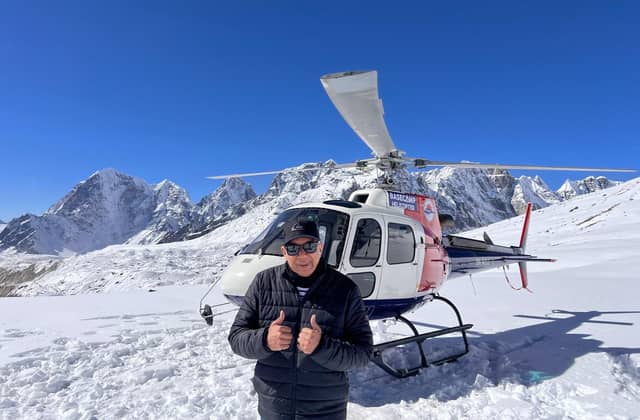
Five passengers and the pilot from Kathmandu. Above Pheriche the load drops to two or three, and landings at Kala Patthar are made two at a time.
Several operators say every passenger has a window seat. Seats are assigned by weight to balance the aircraft, not by booking order.
Not on GetYourGuide. The hotel has 12 rooms and operators sell an overnight as an add-on; sleeping at 3,880 m straight from Kathmandu carries more altitude risk than the day visit.
Not without permits. Drones in Sagarmatha National Park need registration with the aviation authority and several written approvals before the park gives permission.
No. The mountain flight is a one-hour trip by plane with no landing. The helicopter flight lands in the Khumbu and takes half a day.
Where a limit is stated it is 100 kg per passenger. Operators may charge for an extra shuttle; one quotes $500.
Operators set no single rule. Some accept children over 3; listings exclude under 2, under 5 or under 10. The CDC says children are as susceptible to altitude illness as adults.
That figure is a booking fee. The helicopter fare, $1,150–1,850 per person, is paid to the operator separately.
Check dates and today's price: the most-reviewed landing flight on GetYourGuide
Pick your flight. Be back by noon.